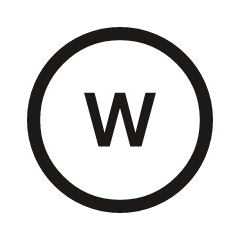
Laundry care symbols, explained

Every care label uses the same five shapes — a tub, a triangle, a square, an iron, and a circle — each covering one part of caring for a garment: washing, bleaching, drying, ironing, and professional cleaning. Once you know what the shape means, the dots, bars, and letters inside it tell you the rest.

This guide follows the international ISO 3758 / GINETEX symbols used on most clothing worldwide, shown here with the wash temperature written as a number. In the US and Canada, ASTM D5489 uses the same five shapes but shows wash temperature as dots instead — the FTC's Care Labeling Rule guide covers that version. Check which symbols are actually printed on your label before assuming either system.

Washing

A tub. The number inside is the maximum water temperature in °C; no number means wash at the temperature appropriate for the fabric. Bars underneath control the machine's agitation and spin — more bars, gentler cycle.


Wash: any temperature, normal cycle
WashAny temperature
Wash at or below 40°C, normal cycle
Wash 40°CNormal cycle
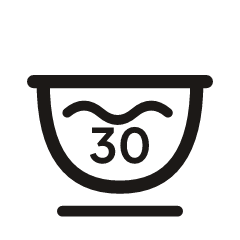
Wash at or below 30°C, permanent press cycle (one bar, medium agitation)
Wash 30°CPermanent press
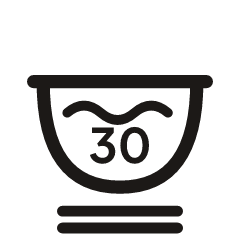
Wash at or below 30°C, delicate or gentle cycle (two bars, minimal agitation)
Wash 30°CDelicate/gentle
Hand wash only, not above 40°C
Hand washNot above 40°C
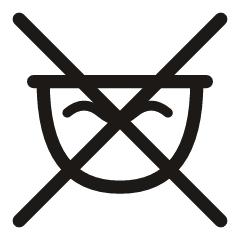
Do not wash under any household conditions
Do not wash

Bleaching

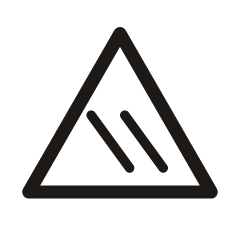
A triangle. Empty means any bleach is fine; two diagonal lines restrict you to non-chlorine (oxygen) bleach only.
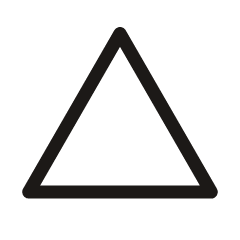
Any bleach allowed, chlorine or non-chlorine
BleachAny type allowed
Non-chlorine (oxygen) bleach only — no chlorine bleach
BleachNon-chlorine only
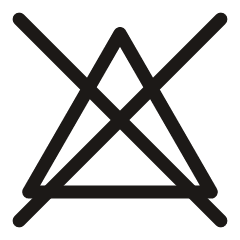
Do not bleach
Do not bleach

Tumble drying

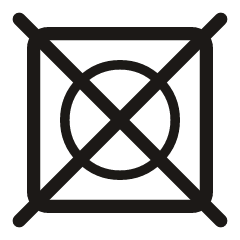
A circle inside a square. One dot means low heat (around 60°C), two dots normal heat (around 80°C); an X means never tumble dry.


Tumble dry, low heat, around 60°C
Tumble dryLow heat, ~60°C
Tumble dry, normal heat, around 80°C
Tumble dryNormal heat, ~80°C
Do not tumble dry
Do not tumble dry

Air drying

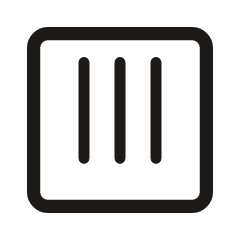
A plain square. What's drawn inside says how: an arch for hanging on a line, three vertical lines for dripping dry without wringing, one horizontal line for laying flat. Two short diagonal lines in the corner add "in the shade" to any of them.


Line dry — hang to dry
Line dry
Line dry in the shade, away from direct sun
Line dryIn the shade
Drip dry — hang while still wet, without wringing
Drip dry
Dry flat on a horizontal surface
Dry flat

Ironing

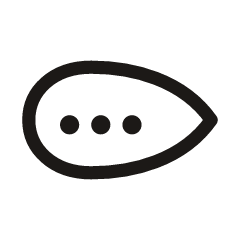
An iron. Dots set the maximum plate temperature — one for synthetics, two for wool and polyester blends, three for cotton and linen.

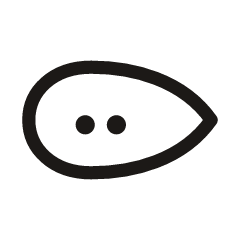
Iron at low temperature, maximum 110°C — synthetics
Iron, lowMax ~110°C
Iron at medium temperature, maximum 150°C — wool
Iron, mediumMax ~150°C
Iron at high temperature, maximum 200°C — cotton, linen
Iron, highMax ~200°C
Do not iron
Do not iron

Professional textile care

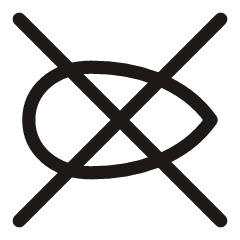
A circle — dry cleaning or professional wet cleaning, not a home washing machine. The letter tells your dry cleaner which solvent is safe for the fabric; you don't need to know which one, just that there's a difference.
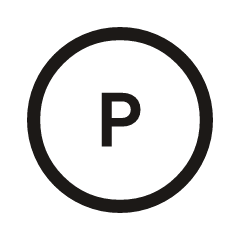
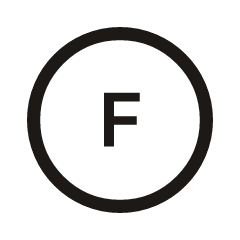
Dry clean using tetrachloroethylene (perc) solvent
Dry cleanTetrachloroethylene
Dry clean using hydrocarbon solvent only
Dry cleanHydrocarbon solvent
Do not dry clean
Do not dry clean
Professional wet cleaning only
Wet cleanProfessional only

Skip the memorizing

LaundryMax reads these symbols straight off a photo of the label — point your camera at the tag and it sorts the garment by wash cycle and color automatically. See how it works.